


Growing up in London, I was privileged to develop a profound connection with the Black community. This deep-rooted relationship has immensely shaped my academic pursuits and research interests. My academic path has led me through archival materials and to develop research that reveals the rich yet often overlooked history of Black Canadians, especially within Southwestern, Ontario. Working alongside several amazing archivists and academics we began to trace the fragment pieces of Black History. Much of this work compares to assembling pieces of a puzzle, connecting significant names, events, community leaders, church and congregational records, and immigration records to decode rich history that is often obscured.
A driving force behind my research is my personal experience within the education system. During my formative years, history classes predominantly highlighted African American figures such as Martin Luther King Jr. and Rosa Parks, framing Black history predominantly through the lens of the American experience. It was not until my undergraduate studies that I encountered a broader spectrum of Black Canadian history. In my second year, a pivotal moment came when a professor introduced me to James F. Jenkins, a figure whose legacy was new to me but profoundly impactful.
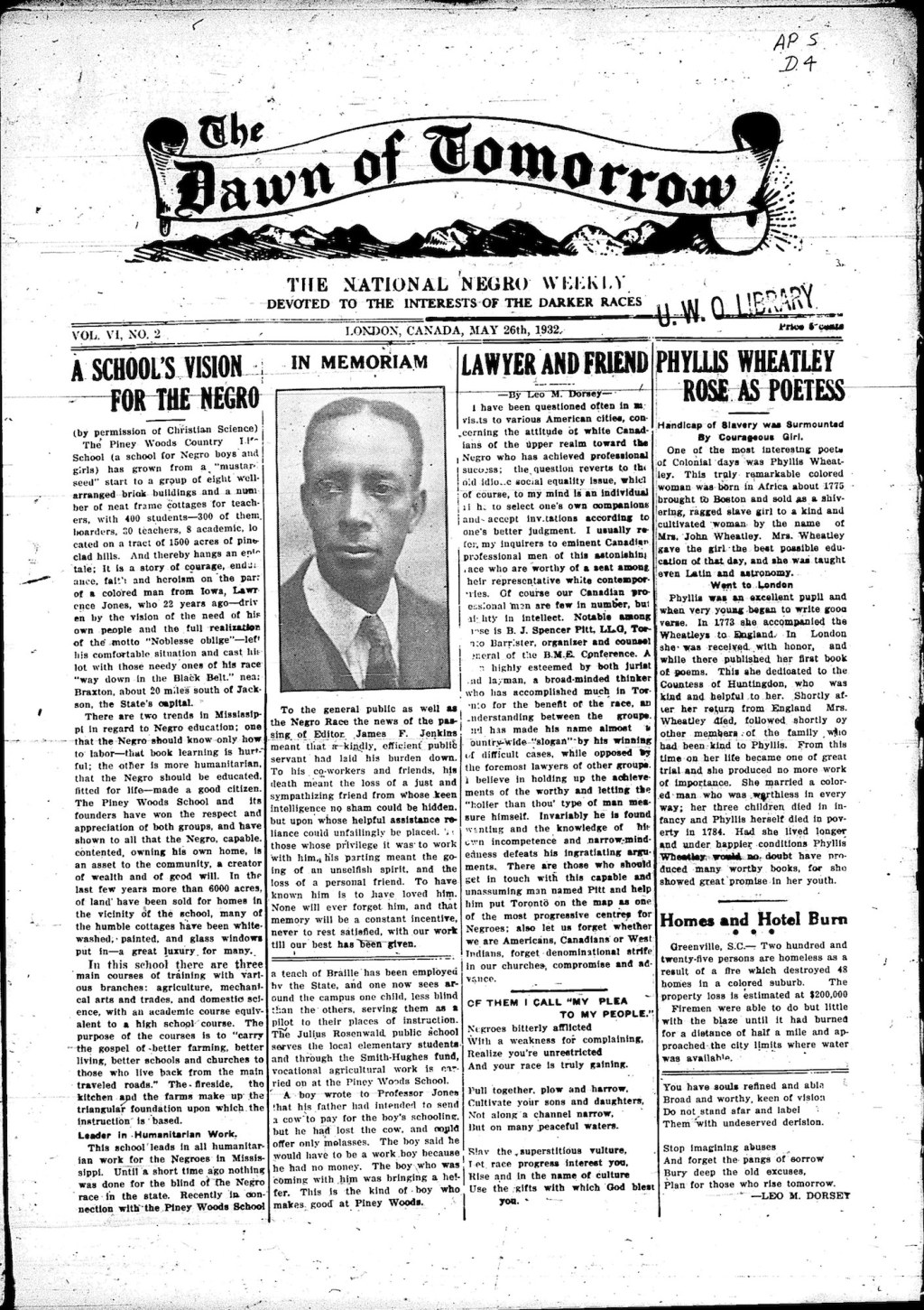
James F. Jenkins, founded of The Dawn of Tomorrow in 1923 ,becoming Canada’s first Black newspaper. Jenkins was born in Georgia in 1884 and moved to London, Ontario in 1907. Upon arriving in Canada and seeing the climate firsthand, Jenkins recognized the importance of intercommunication and building mutual support for the Black community. Through The Dawn of Tomorrow, Jenkins highlighted achievements of Black Canadians, emphasizing a need for connectedness and culture, fostering racial pride, advocating for education, and challenging discriminatory practices. His efforts played a crucial role in shaping a national identity for Black Canadians and forging connections with community allies. One of these early allies was Fred Landon, a historian at Western University, known to be a pioneer writer in Black History and acting president of the Ontario Historical Society (OHS) from 1926-1928.
James Jenkins explored how Black Canadians and Americans could work on a united front for activism and emancipation movements. Jenkins and his wife Christina (Howson) Jenkins were instrumental in advocating for the local Black community in London. They were key figures in Beth Emmanuel (B.M.E) Church, the Family Community Club London, the Canadian League for the Advancement of Colored People, among several others.
Discovering the legacy of James F. Jenkins sparked a profound realization of the untapped potential in understanding Black contributions to Canadian history. As I embark on my journey as a public historian, I aspire to advance knowledge-sharing and digitization of archival materials to reshape the historical narratives surrounding Black communities in Canada. Particularly, I am interested in exploring the experiences of Black individuals and communities in Southwestern Ontario, with a particular emphasis on London.
I hope to uncover the diverse and multifaceted landscape of Black thought, life, knowledge systems and its rich history that has existed for generations through a lens of decolonization by focusing on primary source accounts and records. By addressing the barrier to accessing this vital history, I hope my research can combat cultural erasure and preserve the rich, enduring legacies of Black Canadian. I aspire not only to contribute to a more inclusive and holistic way of collecting historical records and date, but also to ensure that Black experiences and legacies are recognized for the profound impact on our nation’s history.
Image of Dawn of Tomorrow, with editor and founder James Jenkins on the cover

 Neisa Long
Leave a comment